
Bitcoin Miners Hijacked as Attackers Redirect BTC Through Luxor Breach

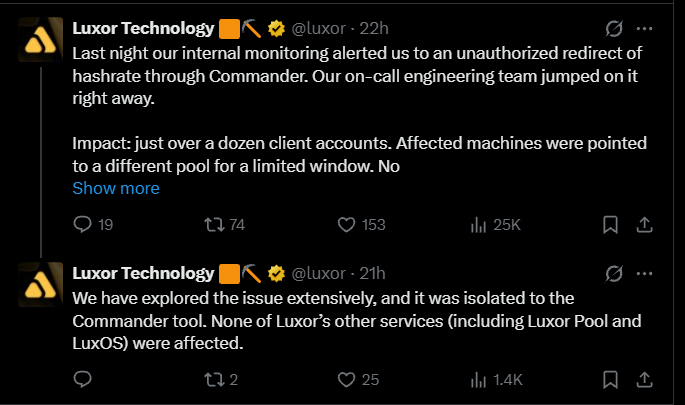
Bitcoin miners hijacked as mining infrastructure provider Luxor has confirmed a security breach involving its Commander management software, which allowed attackers to redirect computing power from more than a dozen customer accounts to another mining pool and change the addresses receiving their rewards.
The incident left affected miners paying electricity costs while their machines continued working for someone else’s benefit. Luxor said it detected the unauthorized activity on November 14, patched the software within two hours, and began restoring the original mining configurations. The company has also promised to reimburse affected customers in full.
Attackers Exploit Luxor Commander to Redirect Mining Rewards
The breach involved Commander, Luxor’s mining-management platform, which allows operators to monitor mining equipment and remotely adjust its settings.
Attackers used unauthorized access to change the mining pool configurations of affected machines and redirect their payout addresses. Instead of sending their computing power to the pools selected by their owners, the machines were pointed toward OCEAN, a Bitcoin mining pool where participants combine their hashrate and receive rewards based on their contributed work.
This type of attack does not require criminals to physically access mining equipment or steal Bitcoin directly from users’ wallets. By changing the pool and payout settings, attackers can redirect the revenue generated by mining machines while their legitimate owners continue covering electricity and operating expenses.
The company also clarified that the incident was isolated to Commander. Its Luxor Pool and LuxOS services were not affected, and it reported no evidence that customer data had been leaked or extracted.
Bitcoin Rewards Worth $15,700 Sent to Attacker-Controlled Address
Blockchain activity indicates that the attackers managed to receive actual mining rewards during the incident.
An address initially identified by mining host CoreX Hosting received three Bitcoin block-reward payments totaling approximately 0.243 BTC. At the time of reporting, the amount was valued at roughly $15,700.
OCEAN’s payout mechanism helps explain why rewards can arrive even after mining machines have stopped contributing. Its system allows previously submitted mining work to remain eligible for a share of subsequent block rewards over a rolling period. Consequently, payments can reach an address after the affected machines have already been returned to their original configurations.
The full financial impact remains unclear, and the identified payments do not establish the total amount of revenue diverted during the incident.
Reports Suggest 64,000 Mining Machines Were Redirected
The incident may have affected considerably more computing power than the number of customer accounts confirmed by Luxor.
Mining operators first raised concerns after noticing unauthorized changes to their equipment’s pool settings. CoreX Hosting reportedly identified the suspicious activity and helped alert other affected operators.
The redirected hashrate subsequently dropped sharply, with reports indicating that it had fallen to approximately 100 petahashes per second. This suggested that most of the affected computing power had been restored or was no longer contributing to the suspicious pool.
Luxor CEO Warns of Increasing AI-Assisted Cyberattacks
Luxor CEO Nick Hansen described the intrusion as involving a sophisticated AI-enabled attack, warning that cryptocurrency businesses are facing increasingly advanced cybersecurity threats.
However, he did not explain precisely how artificial intelligence was used in the breach or disclose how the attackers initially gained access to Commander.
Hansen also said Luxor had paused much of its new feature development to focus on strengthening its security infrastructure. The company has reportedly acquired dedicated GPUs to run its own AI models for defensive security testing.
The warning comes amid growing concerns about the use of artificial intelligence in cyberattacks targeting cryptocurrency companies and blockchain infrastructure providers. AI tools can potentially help attackers identify vulnerabilities and automate parts of the exploitation process, although the specific role of AI in this incident has not been independently established.
Mining Security Concerns Grow After Luxor Breach
The incident highlights a security risk that extends beyond cryptocurrency exchanges and wallet providers. Mining management platforms also control access to valuable infrastructure and determine where the rewards generated by computing power are sent.
Even without directly stealing equipment or accessing miners’ existing Bitcoin balances, attackers who gain control of mining configurations can redirect future earnings and leave operators responsible for the associated costs.
Luxor’s compensation commitment addresses the immediate financial impact for affected customers, but the incident raises broader questions about access controls, monitoring systems, and the security of remotely managed mining operations.
Will Luxor’s promise to fully reimburse affected customers be enough to restore confidence in its mining management software?
Editorial Process for bitcoinist is centered on delivering thoroughly researched, accurate, and unbiased content. We uphold strict sourcing standards, and each page undergoes diligent review by our team of top technology experts and seasoned editors. This process ensures the integrity, relevance, and value of our content for our readers.


