

Altcoins Now Own Half of Binance’s Trading Volume: Liquidity Is Rotating Away From BTC And ETH
Altcoins have been among the most frustrating trades in crypto for the better part of 3 years. Since the 2022 bear market broke valuations across the sector, selling pressure has remained a persistent ceiling on any recovery attempt — and the altseason that cycle after cycle of traders anticipated has delivered more disappointment than it has reward. For most altcoin holders, patience has been the only available strategy.
Something in the volume data is beginning to shift. According to top analyst Darkfost, the consolidation phase the broader market is currently navigating is producing a behavioral change that is visible in how traders are allocating their attention to Binance. During range-bound periods, investors tend to reassess rather than simply hold — and those reassessments are showing up in the platform’s volume distribution.
Today, altcoins account for 51% of total trading volume on Binance — their largest share of the platform’s activity and the first time they have commanded a majority of volume in this cycle. The contrast with early March is striking. At that point, altcoin volumes had contracted sharply to just 31% of Binance’s total, as traders concentrated their activity in Bitcoin and Ethereum during the period of maximum uncertainty.
In six weeks, that share has grown by 20 percentage points. Whether that rotation is the beginning of a genuine altcoin recovery or a consolidation-phase anomaly is the question the data is now forcing.
Capital Is Rotating — and Ethereum Is Feeling It Most
The flip side of altcoins claiming 51% of Binance’s volume is that the capital flowing toward them has to come from somewhere. Bitcoin and Ethereum have both seen their share of platform activity decline, with BTC now standing at 30% and ETH at 17%. The numbers reflect a market that is not simply adding altcoin exposure — it is actively reallocating away from the assets that dominated trading through the most uncertain stretch of the year.

The ETH decline is the more striking of the two. As recently as April 11 — less than two weeks ago — Ethereum still commanded 27% of total trading activity on Binance. It has since shed ten percentage points of that share in less than a fortnight, a pace of rotation that suggests something more deliberate than gradual drift.
Darkfost frames the broader dynamic carefully. Despite the macro uncertainty that continues to define the market environment, a rotation of liquidity from leading assets toward the more speculative segments of the market is clearly underway. Traders appear to be using the range-bound price action not as a reason to reduce exposure, but as an opportunity to reposition toward higher-beta assets that have underperformed through the correction.
Whether that rotation reflects genuine conviction in an altcoin recovery or simply the restlessness of capital looking for movement during a quiet period is the distinction the coming weeks will resolve. For now, the volume data says traders have already made their choice.
Altcoin Market Cap Rebuilds After Structural Breakdown
The total crypto market cap excluding the top 10 assets (altcoins) is currently stabilizing near the $180–$190 billion range after a prolonged period of volatility and structural weakness. The chart highlights a clear cyclical pattern: explosive expansion phases followed by deep corrections, with the most recent drawdown from the 2025 peak near $440 billion cutting valuations by more than half.
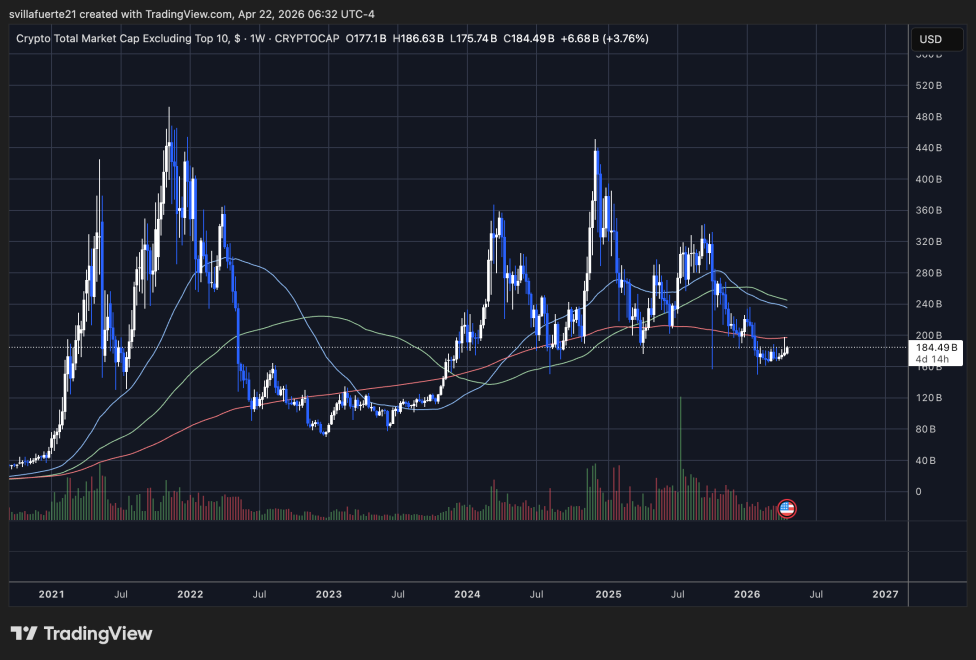
Since the February lows, price action has shifted from capitulation to consolidation. The sharp spike in volume during the sell-off suggests forced liquidations and broad risk-off behavior, while the subsequent recovery has been more measured. The market has managed to reclaim the 200-week moving average, a level that is now acting as tentative support, indicating that long-term buyers are beginning to re-engage.
However, the broader structure remains fragile. The 50-week and 100-week moving averages are flattening and beginning to converge above the current price, creating a compression zone that often precedes a larger directional move. Previous cycles show similar phases where altcoins oscillated in wide ranges before either expanding aggressively or rolling over again.
The inability to reclaim the $220–$250 billion region keeps the market in a neutral-to-bearish posture. For a sustained recovery, altcoins must break above this resistance and confirm higher highs. Until then, this remains a rebuilding phase rather than a confirmed trend reversal.
Featured image from ChatGPT, chart from TradingView.com

Editorial Process for bitcoinist is centered on delivering thoroughly researched, accurate, and unbiased content. We uphold strict sourcing standards, and each page undergoes diligent review by our team of top technology experts and seasoned editors. This process ensures the integrity, relevance, and value of our content for our readers.


